


Let’s discover the Best Outfit Color Combinations for Men and Women | Style Guide with practical styling ideas for casual, office, formal, and seasonal outfits. Learn how to pair navy and white, black and grey, olive and beige, pink and blue, burgundy and cream, brown and beige, white and khaki, and blue with mustard for effortlessly stylish looks.
Best Outfit Color Combinations for Men and Women | Style Guide, This guide also explains Color Wheel & Complementary Color Theory, contrast, tonal dressing, and Skin-Tone & Occasion-Based Color Matching to help you choose shades that complement your personal style.
Introduction
Choosing the right colors can completely change the way an outfit looks and feels. A simple shirt-and-trouser combination can appear polished, modern, relaxed, elegant, or even fashion-forward depending on the colors you put together. That is why understanding the Best Outfit Color Combinations for Men and Women is one of the easiest ways to improve your everyday style without constantly buying new clothes.
You do not need an enormous wardrobe to dress well. In many cases, a few reliable colors can create dozens of attractive outfits. Navy, white, black, grey, beige, olive, brown, burgundy, pink, mustard, khaki, and classic blue can all work beautifully when they are balanced correctly.
The key is not simply matching two colors that look good individually. Great outfit coordination also considers contrast, fabric, season, occasion, personal style, and even your skin tone. A color combination that looks perfect for a summer brunch may feel out of place at a formal evening event. Similarly, a bold pairing that works wonderfully for streetwear may not be appropriate for a business meeting.
Fortunately, color coordination does not have to be complicated.
Whether you are putting together a casual weekend outfit, planning a professional look, dressing for a wedding, or refreshing your seasonal wardrobe, learning a few dependable color combinations can make getting dressed much easier.
1. Understand Color Theory Before You Match Your Clothes
Before looking at specific outfit combinations, it helps to understand the basic principles behind clothing colors.
You have probably noticed that some colors naturally seem to complement one another while others compete for attention. This is where the Color Wheel & Complementary Color Theory becomes useful.
A color wheel organizes colors according to their relationships. Complementary colors sit opposite one another and create strong visual contrast. Analogous colors sit next to each other and generally create a softer, more harmonious appearance.
You do not need to become a professional stylist to use these concepts. A few simple rules can make a significant difference.
Use one dominant color
One of the easiest styling approaches is to choose a dominant color and use another color as an accent.
For example:
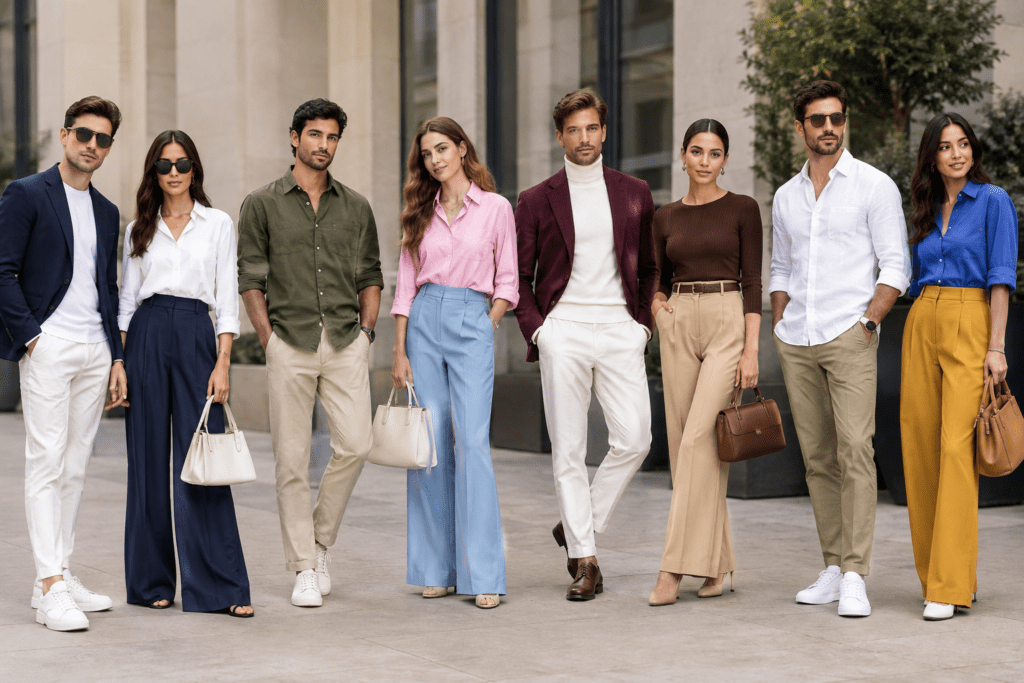
- Navy trousers + white shirt + brown shoes
- Beige trousers + olive shirt + cream accessories
- Black dress + burgundy handbag
- Grey suit + pale blue shirt
- Brown trousers + cream knitwear
The dominant color creates the foundation, while the secondary color adds interest.
Balance warm and cool colors
Colors such as red, orange, mustard, burgundy, and warm brown generally feel warmer. Blue, navy, green, and some shades of grey often feel cooler.
Combining warm and cool shades can create attractive contrast.
For instance, a navy shirt with mustard trousers can look energetic because the cool navy balances the warmth of mustard. On the other hand, brown and beige create a more understated tonal appearance because both belong to a warm, earthy family.
Don’t overlook neutrals
Neutrals are the foundation of versatile wardrobes.
Black, white, grey, beige, cream, navy, brown, and khaki can be combined with almost everything. If you are unsure about wearing brighter colors, start with neutral clothing and introduce color through one statement piece.
This approach makes experimenting with fashion much easier.
2. Classic Color Combinations That Work for Men and Women
Some combinations remain popular because they are incredibly versatile. They can be dressed up or down and adapted to different seasons, personal styles, and occasions.
Navy Blue & White Outfit Combination
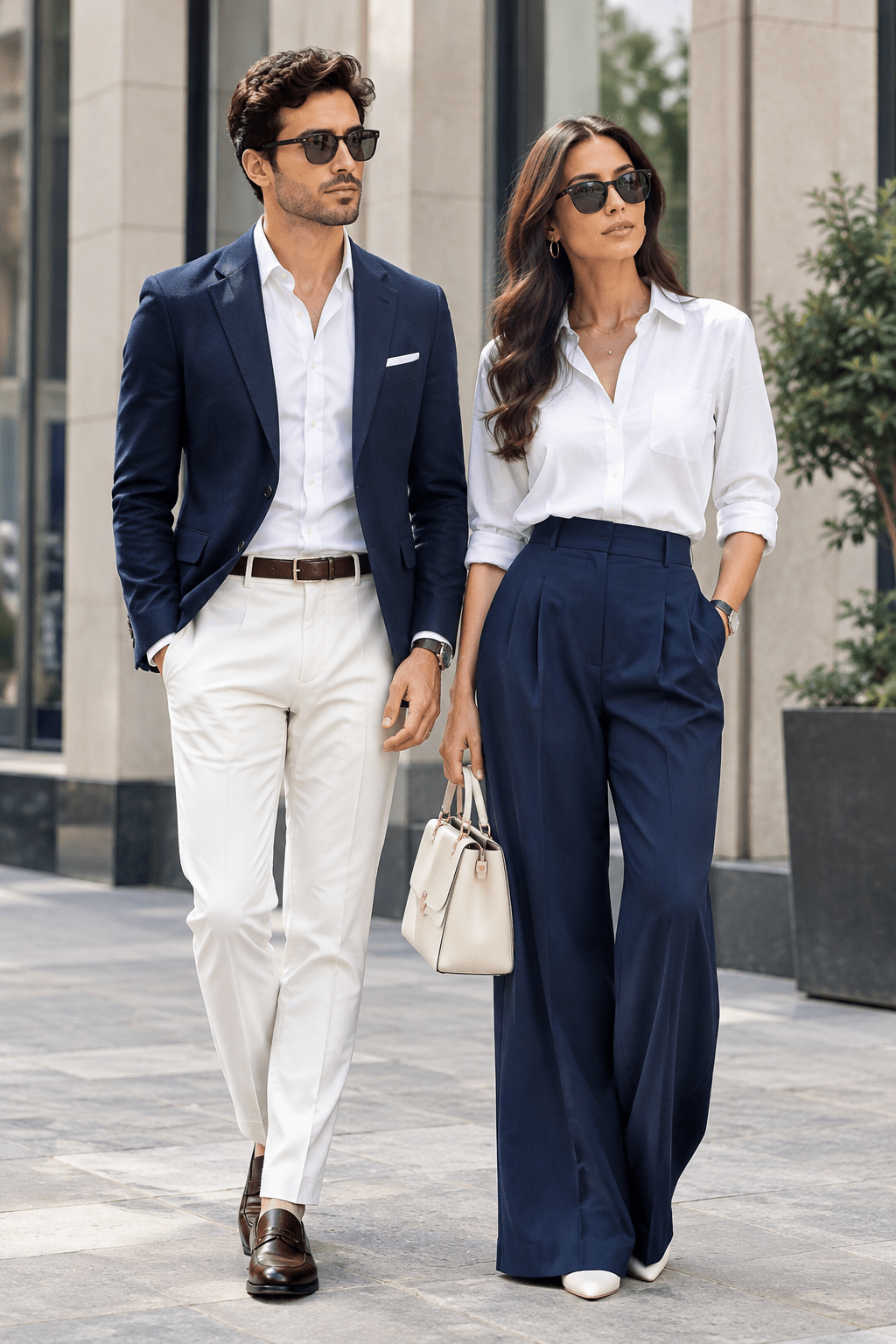
The Navy Blue & White Outfit Combination is one of the safest and most timeless choices for both men and women.
Navy provides depth and sophistication, while white adds brightness and freshness. Together, they create a clean appearance that can work for casual, business, resort, and semi-formal dressing.
For men, try a navy blazer with a crisp white shirt, beige chinos, and brown loafers. For a more casual approach, combine a navy polo shirt with white jeans or trousers and minimalist sneakers.
Women can experiment with a navy midi dress and white accessories, a white blouse with navy trousers, or a navy blazer layered over a white top.
This combination is particularly useful during spring and summer because white keeps the outfit visually light while navy prevents it from looking too casual.
For an effortless weekend outfit, consider:
Men: Navy polo + white chinos + brown loafers
Women: White blouse + navy wide-leg trousers + tan sandals
The combination is simple, but it rarely looks boring.
Black & Grey Monochrome Palette
For people who prefer minimalist dressing, the Black & Grey Monochrome Palette is an excellent choice.
Black and grey offer different levels of depth while staying within the same neutral family. The result is sophisticated without requiring bright or contrasting colors.
Men can wear a charcoal grey suit with a black shirt for an evening look. For casual styling, black jeans with a grey sweatshirt and black sneakers create a modern streetwear-inspired outfit.
Women can combine a charcoal blazer with black trousers, a grey knit dress with black boots, or a light-grey top with black tailored pants.
The secret to making monochrome outfits interesting is texture.
Instead of wearing completely flat fabrics, mix materials such as:
- Wool
- Cotton
- Denim
- Leather
- Knitwear
- Suede
- Satin
A charcoal wool coat over a black knit outfit, for example, has much more visual depth than wearing two identical fabrics.
Monochrome dressing also makes accessories particularly important. A watch, handbag, belt, sunglasses, or shoes can become the finishing detail that gives the outfit personality.
Brown & Beige Tonal Styling
If you love understated luxury, Brown & Beige Tonal Styling is worth adding to your wardrobe.
This combination uses different shades within the same warm color family. Instead of relying on dramatic contrast, it creates depth through variations in tone.
For men, consider:
- Beige shirt
- Chocolate-brown trousers
- Tan leather belt
- Brown loafers
For women, a beige knit top paired with chocolate trousers and camel accessories can create an elegant everyday look.
Tonal styling is especially effective with natural fabrics. Linen, cotton, suede, wool, and leather can make neutral shades appear richer and more sophisticated.
You can also use three shades instead of two. For example, combine cream, camel, and chocolate brown in one outfit.
The result is subtle but visually appealing.
Olive Green & Beige Earth-Tone Pairing
The Olive Green & Beige Earth-Tone Pairing is another versatile combination that works beautifully for casual and smart-casual outfits.
Olive green has a natural, muted quality, while beige provides a soft neutral foundation. Because neither color is excessively bright, they are easy to wear throughout the year.
Men could pair an olive overshirt with a beige T-shirt, cream chinos, and brown sneakers. Women might combine an olive utility jacket with beige trousers and neutral sandals.
This color pairing works particularly well with relaxed silhouettes.
Try it with:
- Cargo trousers
- Overshirts
- Linen shirts
- Utility jackets
- Wide-leg trousers
- Knit tops
- Casual dresses
For a modern everyday look, olive can also be used as an accent rather than the main color. An olive handbag, jacket, cap, or sneaker can add personality to an otherwise neutral outfit.
3. Fashion-Forward Color Combinations for a More Expressive Wardrobe
Once you are comfortable with classic neutrals, introducing stronger color combinations can make your wardrobe more exciting.
The trick is to control the amount of color rather than avoiding it completely.
Pink & Blue Color Combination
The Pink & Blue Color Combination has become increasingly versatile because both colors come in countless shades.
A soft blush pink paired with pale blue creates a gentle, refined look. Bright pink with deep navy feels much more energetic. Dusty rose with denim offers a relaxed everyday aesthetic.
For men, there is no reason to avoid pink. A pale pink Oxford shirt with navy trousers is a classic combination suitable for work, dates, and smart-casual occasions.
For women, try a pink blouse with blue denim, a powder-blue blazer with a pink top, or a navy dress accessorized with pink shoes or a handbag.
The important consideration is intensity.
If both colors are extremely bright, the outfit can become visually overwhelming. Pairing one stronger shade with a softer version often creates better balance.
For example:
Soft pink + navy = sophisticated
Blush pink + denim blue = casual
Hot pink + cobalt blue = bold and fashion-forward
Burgundy & Cream Contrast
For autumn, winter, evening events, and sophisticated occasions, Burgundy & Cream Contrast is an excellent choice.
Burgundy adds richness and visual depth, while cream softens the intensity of the darker red tone.
Men can wear a burgundy sweater with cream trousers or a cream shirt underneath a burgundy blazer. Women can pair a burgundy skirt with a cream knit top or choose a cream dress with burgundy accessories.
Unlike bright red, burgundy generally feels more sophisticated and easier to incorporate into an everyday wardrobe.
It works particularly well with:
- Wool
- Velvet
- Leather
- Suede
- Knitwear
- Satin
For a dinner or evening event, try burgundy trousers, a cream blouse, and dark brown footwear.
For a casual winter outfit, a burgundy sweater with cream or beige trousers creates a warm and polished appearance.
Blue & Mustard Color Contrast
If you want a combination that feels more adventurous, try Blue & Mustard Color Contrast.
Blue and mustard create noticeable contrast without appearing excessively loud when the shades are selected carefully.
Deep navy looks especially good with mustard because the darker blue grounds the brighter yellow-based shade.
Men can wear a mustard overshirt with navy trousers or a mustard knit under a navy jacket. Women can try a mustard blouse with dark-blue jeans, a navy skirt with mustard accessories, or a mustard sweater with tailored blue trousers.
This combination works especially well during autumn because mustard naturally complements seasonal textures and colors.
If you are hesitant about wearing mustard as a major part of your outfit, introduce it through accessories:
- Handbag
- Scarf
- Shoes
- Belt
- Watch strap
- Hat
This allows you to experiment without changing your entire wardrobe.
4. How to Choose Outfit Colors According to Skin Tone and Occasion
Finding the Best Outfit Color Combinations for Men and Women is not only about following fashion trends. Personal coloring and the occasion also matter.
Skin-Tone & Occasion-Based Color Matching
Skin-Tone & Occasion-Based Color Matching can help you determine which shades are likely to complement your natural appearance and which combinations are most appropriate for different settings.
While there are no absolute rules, people often find that certain color families harmonize particularly well with their complexion.
Rather than worrying about strict categories, pay attention to how a color interacts with your face.
Hold different shades near your face and notice whether they make your complexion appear brighter and more balanced or washed out.
For everyday casual outfits
Casual clothing gives you more freedom.
Denim blue, white, beige, olive, grey, brown, and muted pastels are excellent starting points.
Examples include:
- White T-shirt + blue jeans
- Olive shirt + beige trousers
- Grey sweatshirt + black jeans
- Pink top + blue denim
- Brown overshirt + cream trousers
For office wear
Professional environments usually benefit from controlled color combinations.
Navy, charcoal, white, cream, grey, black, and muted blue are reliable choices.
For example:
Men: Navy blazer + white shirt + grey trousers
Women: Cream blouse + navy trousers + structured blazer
If your workplace allows more color, burgundy, olive, or muted mustard can be introduced through accessories or individual garments.
For weddings and celebrations
Special occasions are ideal for richer colors and elevated textures.
Burgundy, deep blue, emerald, cream, champagne, chocolate brown, and sophisticated jewel tones can create a polished appearance.
Women can use color through dresses, sarees, suits, handbags, or footwear. Men can incorporate richer colors through blazers, shirts, ties, pocket squares, or traditional attire.
For summer
Summer outfits generally benefit from lighter shades.
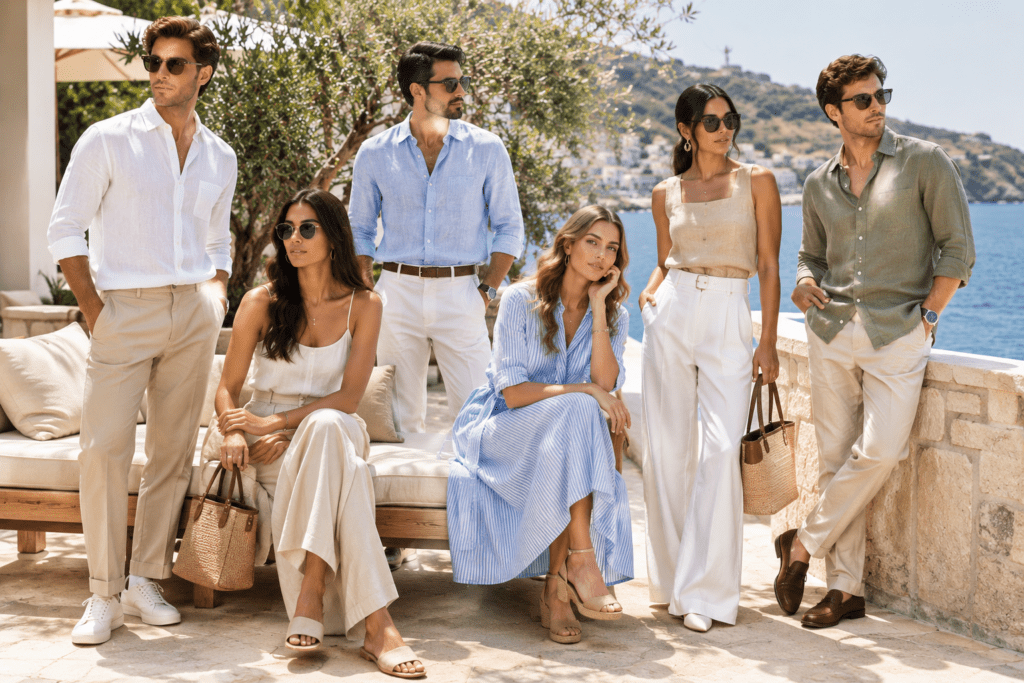
White, cream, khaki, pale blue, beige, soft pink, and light green can create an airy appearance.
The White & Khaki Summer Color Pairing is particularly useful because it combines two light neutrals without looking completely monochromatic.
Men can wear a white linen shirt with khaki trousers and loafers. Women can try a white cotton top with a khaki skirt or wide-leg trousers.
This combination is especially effective for vacations, brunches, outdoor gatherings, and relaxed daytime occasions.
5. Practical Styling Rules for Better Color Coordination
Knowing individual color combinations is useful, but understanding how to apply them is even more important.
Follow the three-color rule
A simple styling guideline is to keep most outfits within three major colors.
For example:
Navy + white + brown
or
Beige + olive + cream
or
Black + grey + burgundy
This does not mean an outfit can never contain more than three colors. Accessories, prints, and small details can introduce additional shades. However, limiting your primary colors helps the outfit look intentional.
Use the 60-30-10 approach
Another useful styling concept is to think of your outfit in proportions.
Approximately:
- 60% dominant color
- 30% secondary color
- 10% accent color
For example, imagine an outfit consisting of beige trousers and a cream shirt. Beige and cream form most of the outfit, while a burgundy handbag or shoes provide the accent.
This technique is particularly useful when wearing brighter colors.
Consider contrast carefully
High contrast creates a stronger visual statement.
Examples include:
- Navy + white
- Black + white
- Blue + mustard
- Burgundy + cream
Lower contrast creates a softer appearance.
Examples include:
- Beige + cream
- Brown + camel
- Olive + beige
- Grey + charcoal
Neither approach is better. They simply create different moods.
If you prefer minimalist fashion, lower-contrast combinations may feel more natural. If you enjoy expressive fashion, stronger contrasts can make your outfits more memorable.
Match the color intensity
One common mistake is combining colors with completely different visual intensity without considering balance.
A neon top with an extremely bright pair of trousers may create too much competition.
Instead, try pairing a strong color with a neutral or subdued shade.
For example:
Mustard + navy
works because navy provides a grounded base.
Similarly:
Burgundy + cream
works because cream softens the richness of burgundy.
Building a Versatile Color-Based Wardrobe
You do not need every color in your closet. A carefully selected palette can provide much more flexibility.
Start with a few dependable foundation colors:
- Black
- White
- Navy
- Grey
- Beige
- Brown
- Denim blue
Then add two or three personality colors.
These could include:
- Burgundy
- Olive
- Pink
- Mustard
- Emerald
- Cobalt blue
This gives you a wardrobe where most pieces can be mixed and matched.
For example, a navy trouser can work with a white shirt, pink shirt, cream sweater, grey polo, olive overshirt, or burgundy knit.
Similarly, beige trousers can be paired with navy, white, olive, brown, black, blue, or burgundy.
This is one reason neutral clothing is so valuable.
Instead of thinking about individual outfits, think about creating a color system.
Common Color-Matching Mistakes to Avoid
Even attractive colors can look awkward if they are used incorrectly.
Wearing too many statement colors
If every item is designed to attract attention, the outfit can lose visual focus.
Choose one primary statement shade and let the rest of the outfit support it.
Ignoring the occasion
A bright color combination may look fantastic at a music festival but feel inappropriate in a formal business setting.
Always consider where you are going before selecting your colors.
Forgetting footwear
Shoes can significantly affect the overall color balance.
Brown shoes generally work beautifully with navy, beige, cream, olive, and many warm shades. Black shoes are particularly versatile with black, grey, navy, and formal outfits.
Matching everything too perfectly
There is a difference between coordination and exact matching.
Your handbag does not necessarily need to be the same color as your shoes. Your belt does not always need to match your shirt.
A little variation often makes an outfit look more natural and contemporary.
Ignoring fabric
The same color can look completely different depending on the material.
Cream linen feels relaxed and summery. Cream satin feels luxurious. Cream wool feels warm and sophisticated.
Therefore, color selection should always be considered alongside texture and fabric.
Outfit Color Combination Ideas at a Glance
If you need quick inspiration, start with these combinations:
| Color Combination | Best For | Style Mood |
|---|---|---|
| Navy + White | Office, casual, summer | Classic and clean |
| Black + Grey | Evening, work, minimalism | Sophisticated |
| Olive + Beige | Casual, travel, weekend | Relaxed and earthy |
| Pink + Blue | Casual, smart-casual | Fresh and modern |
| Burgundy + Cream | Evening, winter, occasions | Elegant and rich |
| Brown + Beige | Everyday, work, autumn | Refined and warm |
| White + Khaki | Summer, vacation, daytime | Light and effortless |
| Blue + Mustard | Casual, autumn, street style | Bold and energetic |
The goal is not to memorize every possible combination. Instead, learn how different color relationships work and then adapt them to your own wardrobe.
Conclusion: Best Outfit Color Combinations for Men and Women | Style Guide
Finding the Best Outfit Color Combinations for Men and Women does not require complicated fashion rules. The most successful outfits usually begin with a strong foundation of versatile colors and then introduce contrast, texture, or a carefully selected accent shade.
Classic combinations such as Navy Blue & White Outfit Combination, Black & Grey Monochrome Palette, and Brown & Beige Tonal Styling are excellent choices when you want timeless and dependable outfits. For something more expressive, Pink & Blue Color Combination, Burgundy & Cream Contrast, and Blue & Mustard Color Contrast can bring additional personality to your wardrobe.
Earthy combinations such as Olive Green & Beige Earth-Tone Pairing are perfect for relaxed everyday dressing, while White & Khaki Summer Color Pairing is an easy choice for warm-weather outfits.
Most importantly, do not treat color rules as strict laws. Fashion is personal. Your skin tone, lifestyle, wardrobe, personality, climate, and occasion should all influence your choices. Use Color Wheel & Complementary Color Theory as a helpful starting point, then experiment until you discover combinations that feel authentic to you.
Start with a few colors you already love. Pick one new combination, build an outfit around it, and see how it feels. With a little experimentation, creating stylish, coordinated outfits becomes much easier—and your wardrobe becomes far more versatile in the process.
If you are refreshing your wardrobe this season, use these combinations as inspiration and start creating outfits that feel polished, confident, and uniquely yours.
Schema-FAQs: Best Outfit Color Combinations for Men and Women | Style Guide
FAQ 1: What are the best outfit color combinations for men and women?
Some of the most versatile combinations include navy and white, black and grey, olive and beige, brown and beige, pink and blue, burgundy and cream, white and khaki, and blue and mustard. The best choice depends on personal style, skin tone, season, and occasion.
FAQ 2: What are the most versatile clothing colors?
Black, white, navy, grey, beige, brown, and khaki are among the most versatile clothing colors. They can be mixed with brighter shades or combined with one another to create simple, sophisticated outfits.
FAQ 3: Does navy blue go well with white?
Yes. A Navy Blue & White Outfit Combination is a classic choice for men and women. It creates a clean, sophisticated appearance and can be adapted for casual, office, smart-casual, and semi-formal occasions.
FAQ 4: Is black and grey a good outfit combination?
Yes. A Black & Grey Monochrome Palette creates a sophisticated and minimalist appearance. Different shades of grey, combined with black clothing and contrasting textures, can add depth to the outfit.
FAQ 5: Do olive green and beige go together?
Yes. The Olive Green & Beige Earth-Tone Pairing is excellent for casual and smart-casual dressing. The muted green and neutral beige create a relaxed, natural color palette that works especially well with cotton, linen, suede, and other textured fabrics.
FAQ 6: Can men wear pink with blue?
Absolutely. The Pink & Blue Color Combination works particularly well when one shade is softer or more muted. For example, a pale pink shirt with navy trousers creates a polished men’s outfit suitable for work, dates, and smart-casual occasions.
FAQ 7: Is burgundy and cream a good color combination?
Yes. Burgundy & Cream Contrast creates an elegant and sophisticated appearance. Burgundy provides richness and depth, while cream creates a softer balance. This combination works particularly well for evening, autumn, winter, and special-occasion outfits.
FAQ 8: What colors go well with brown clothes?
Brown works well with beige, cream, white, olive, navy, blue, and burgundy. Brown & Beige Tonal Styling is especially effective when you combine different shades and textures to create a sophisticated tonal outfit.
FAQ 9: What is a good summer outfit color combination?
White & Khaki Summer Color Pairing is a dependable summer option. White keeps the outfit fresh and bright, while khaki adds warmth and structure. Linen shirts, cotton trousers, dresses, skirts, and relaxed tailoring work particularly well with this palette.
FAQ 10: What color goes well with mustard?
Navy and other deep shades of blue work especially well with mustard. Blue & Mustard Color Contrast creates an energetic yet balanced look and can be used in casual, smart-casual, and autumn outfits.
FAQ 11: How do I choose clothing colors for my skin tone?
Use Skin-Tone & Occasion-Based Color Matching as a flexible guideline rather than a strict rule. Try different shades near your face and observe which ones make your complexion appear brighter and more balanced. Also consider the occasion, lighting, season, and overall outfit contrast.
FAQ 12: How does the color wheel help with outfit styling?
Color Wheel & Complementary Color Theory helps explain how different colors relate to each other. Complementary colors create stronger contrast, while analogous colors create a more harmonious appearance. Using these relationships can make outfit coordination easier.
FAQ 13: How many colors should an outfit have?
A practical starting point is to use two or three main colors. For example, navy, white, and brown create a balanced combination. However, accessories and patterns can introduce additional shades when used thoughtfully.
FAQ 14: Should shoes match the color of an outfit?
Shoes do not need to exactly match your clothing. Instead, they should complement the overall palette. Brown footwear works well with navy, beige, olive, cream, and many warm tones, while black footwear is particularly versatile with black, grey, navy, and formal outfits.
FAQ 15: What is the easiest way to improve outfit color coordination?
Start with neutral foundation colors such as black, white, navy, grey, beige, and brown. Then introduce one personality color such as burgundy, olive, pink, mustard, or cobalt blue. This creates a versatile wardrobe while making it easier to experiment with color.
For More Blog: NewLookColection.Com
Follow Us On: YouTube.Com
Please follow and like us:


